
🛎️ Vibrational Medicine
The Science of Sound for a Healthy Nervous System

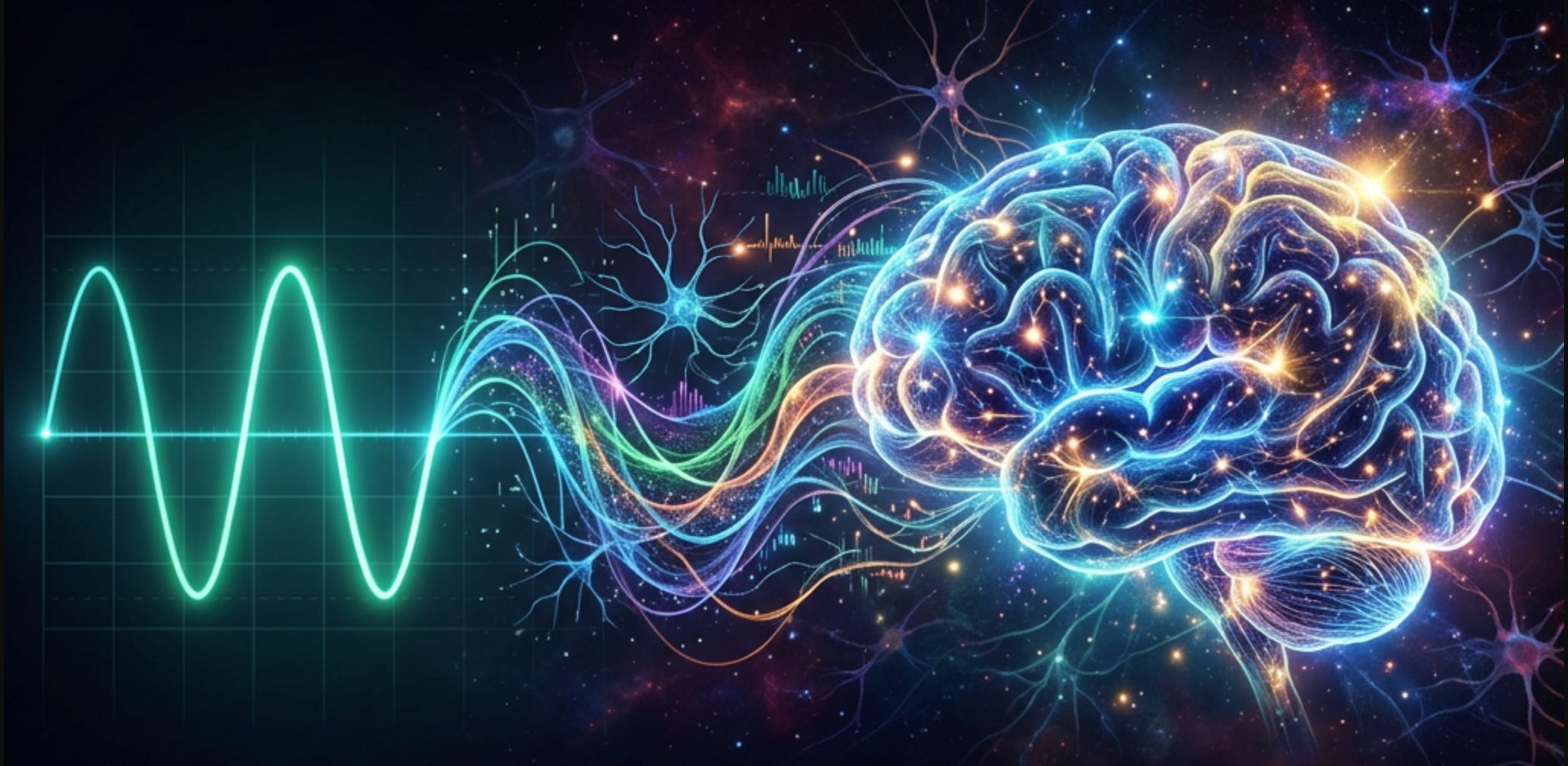
It’s been a month since I’ve added sound to my table sessions. Once I did it, it was obvious how well they went together. I found my brain and body really like standing in front of the gong, especially. It’s trancey and finding the rhythm when I’m swaying and striking the gong becomes pretty psychedelic pretty quickly. Turns out the altered state is actually healing for the brain and nervous system and it works on me while I’m playing as well as the person on the table.
There’s a decent amount of science backing sound healing for brain health. So, when my friend left me with a 32 inch gong and Tibetan singing bowls while she traveled Central America, I looked into it, and it’s true, sound healing is legit.
If you’ve been reading, my newsletters know that I took a brain retraining class this winter and I continue to learn a little bit more day by day and I’m trying to make healthier choices for my nervous system. My aim is at the most important factors; relationships, novelty, diet, exercise, and sleep. Sometimes it’s easy to forget how much each one of these factors impacts the shape of our brains.
In 1890, William James coined the term plasticity and defined it as “a structure weak enough to yield to an influence, but strong enough not to yield all at once.” [1]
Today neuroplasticity is commonly defined as the brains lifelong ability to reorganize itself in response to experience The brain can be influenced, it takes a shape relative to it’s environment and retains it’s capacity to reorganize it’s structure, function, and connections in response to learning or injury. [2]
For anyone who is struggling with stress, anxiety, depression, or has been brain injured, it’s helpful to know that brain’s have the ability to heal and regenerate, make new connections between neurons, and build and regrow synaptic connections through vibration, rhythm, and focused attention. This is where sound healing factors in.
In a meta-analysis study [3] measurable physical changes were noticed in the brain after sound therapy. 528HZ (alternatively known as the love frequency) was found to reduce oxidative stress in animal studies as well as increase brain testosterone.
Another interesting finding was that 432HZ showed improvements in sleep for spinal cord injured patients relative to 440HZ. A number of studies have supported the healing benefits of 432HZ versus 440HZ [4]. Oddly, most music is tuned to 440HZ and the subtle shift in frequency and impacts goes largely unrecognized. Sadly, we don’t take the subtle into account. Once you notice the difference, it’s like listening to songbirds versus listening to crows.
Another study using Tibetan Singing Bowls showed that sound can trigger brain entrainment. The brain’s electrical activity aligns with musical rhythms and supports relaxation.
“Most studies reported significant reductions in anxiety and depressive symptoms, improvements in well-being and quality of life, increases in Heart Rate Variability, and decreases in heart rate. Some studies also found increased Delta and Theta brainwave activity.” [5]
These findings support claims that sound therapy is good for nervous system regulation by supporting shifts from stress to relaxation. And it’s as easy as popping in some headphones and turning on a YouTube of 528HZ.
A 2023 study found evidence to support brainwave pattern synchronization, those associated with deep meditative states.
“The experimental results showed that the increases (up to ~251%) in the spectral magnitudes of the brain waves were dominant at the beat frequency compared to those of any other clinical brain wave frequency bands. The observed synchronized activation of the brain waves at the beating sound frequency supports that the singing bowl sound may effectively facilitate meditation and relaxation, considering that the beat frequency belongs to the theta wave region which increases in the relaxed meditation state.” [6]
Singing bowl meditation was shown to increase positive feelings (affect) in cancer patients and high-risk youth. In this study, it turned out that people new to the experience received the most benefits:
“…participants who were previously naïve to this type of meditation experienced a significantly greater reduction in tension compared with participants experienced in this meditation (P < .001). Feeling of spiritual well-being significantly increased across all participants (P < .001). Tibetan singing bowl meditation may be a feasible low-cost low technology intervention for reducing feelings of tension, anxiety, and depression, and increasing spiritual well-being. This meditation type may be especially useful in decreasing tension in individuals who have not previously practiced this form of meditation.” [7]
So there you have it. A brief science of sound healing. If you haven’t tried it, you can find a sound healing practitioner near you or search YouTube for binaural beats and other healing frequencies.
🛎️
References/ Links to Research:
1. https://en.wikipedia.org/wiki/Neuroplasticity
2. https://www.ncbi.nlm.nih.gov/books/NBK557811/
3. https://pubmed.ncbi.nlm.nih.gov/40868617/
4. https://pubmed.ncbi.nlm.nih.gov/31031095/
5. https://pmc.ncbi.nlm.nih.gov/articles/PMC12385955/
Yes indeed. I've experienced this as well and love that you've weaved sound to your work!