
Prediction Error & Attuned Touch
How the Nervous System Heals, Bottom-Up

Four years ago, an osteopath told me my head was concrete. She nailed the felt sense. What follows is what I’ve learned about how the nervous system gets that way and the conditions for melting concrete.
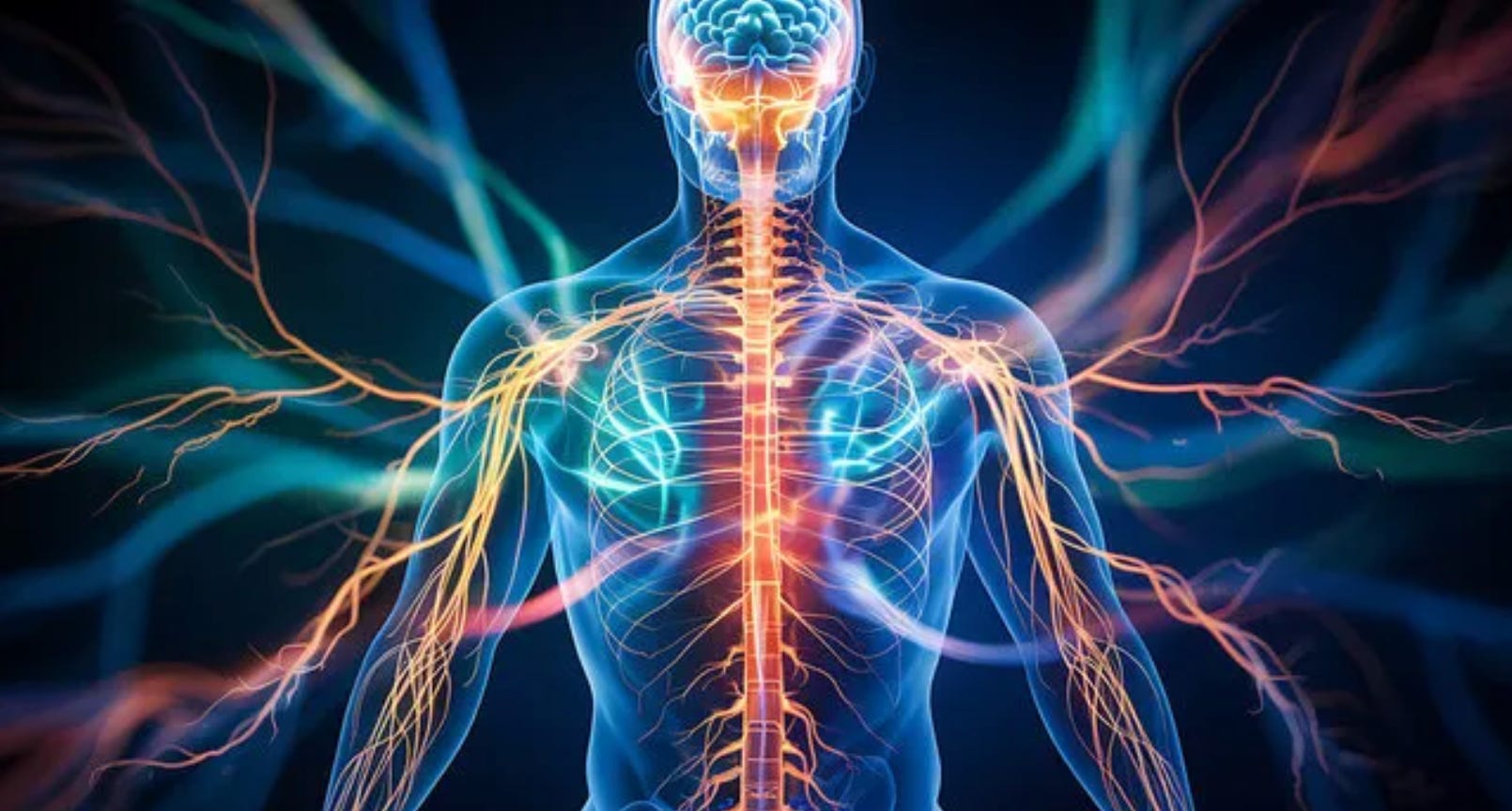
Nervous System as Prediction Machine
The nervous system is a prediction machine. I don’t love the mechanistic framing, but it’s useful. It continuously registers incoming sensory information and updates its models when mismatches occur. When overwhelmed, it can become calibrated around threat, overweighting danger signals while underweighting safety. The loop can perpetuate chronic dysregulation long after the original threat has passed.
Internal arts are practices of interoception. Interoception is how the nervous system reads signals inside the body. It’s registering the internal awareness of emotional states, physical needs, as well as more subtle sensations and shifts in the inner landscape. Continuous misinterpretation of these signals embeds prediction errors into neural functioning leaving the system stuck.
Long after a threat has passed, numbness persists, or physiological arousal signals danger in environments that could be considered “safe.” The system gets stuck looping its own futuristic memory- it’s remembering the past through a trigger in the present and organizing the whole body around defending against it. After time, it becomes very expensive to be at war with yourself.
Bottom-up Processing
Bottom-up processing is the process of raw sensory input updating cognition and physiology through the body rather than through the mind. It’s slower than top-down approaches, which work through the frontal cortex using mental models and past experience. But it’s more accurate and for a system stuck in threat prediction, it’s the vector of choice for meaningful change and health.
I was seeing clients through much of this concrete and attempting to finish my degree. How could I have worked like this? When I look back, sometimes I’m unsure myself.
There’s a joke in the field: how do you regulate a therapist?
Put a client in front of them.
It’s pretty amazing what a system can withstand. We are stronger and more resilient than we think. What’s also true is the capacity to override our experience is what often lands us in burnout, illness and collapse. Bodies are designed to rest, culturally we forget this.
From a bottom-up perspective, healing can center on what researchers call “prediction error correction.” The moments when the nervous system updates its models because expectation doesn’t match current reality. When threat is anticipated but safety is received instead. That mismatch becomes an opening.
Attuned touch, delivered correctly, creates the mismatch necessary for updating the system. Contact. Magic. Relief. I’m not saying the world is safe, it’s absolutely not, at all. But to live here in the world, prioritizing the health of our nervous systems is primary.
A top-down practice that assists with this transformation from frozen or concrete involves understanding the research on Cell Danger and checking: “right now, am I ok?”
“In this micro-moment, for this breath, am I ok?”
A tip and slight tangent; it’s helpful to come back to the body when overwhelmed by something like the layers of illness or the news. This can be done with a breath and this simple inquiry. Otherwise stress compounds and eventually the concrete sets.
Latent State Theory and Fear Extinction
According to “latent state theory,” small prediction errors don’t generate genuine updates. They fold new experiences into existing memory states, creating interference rather than change. Large prediction errors are different. They generate entirely new memory traces, minimizing interference and facilitating real learning. Counterintuitive, but the research is clear. Sufficient surprise is required to reorganize threat-related predictions.
Studies on “fear extinction” support this too. Gradual reduction of threat intensity produces more durable extinction than sudden removal. Gentle, progressively calibrated interventions produce more stable nervous system reorganization than forceful ones. The nervous system learns when prediction fails, when sensory information contradicts expectation. Repetitive predictable input reinforces existing neural models. Surprising sensory experience generates updates but only within a window of tolerance.
Familiar therapeutic interventions plateau and fail to shift trauma responses when the nervous system’s prediction envelope has been sealed because it’s already accounted for them. Novel approaches involving touch catalyze change because they create prediction errors large enough to trigger reorganization.
The Catalyst: Surprise
In January 2024 a fellow craniosacral practitioner visited me at my apartment weekly. I couldn’t stand at the time. He was in his 70’s, former businessman who had sustained serious injuries in a car wreck and changed course into the healing arts late in his career. He showed up every Wednesday for me. He’d tell me stories for two hours, move his car for the 2 hour parking meter, come back and offer an hour of craniosacral work, then sit with me after.
Sometimes we sat in silence. He did this for free, eight weeks in a row, at a point when I was afraid to speak to anyone about how my nervous system felt like it was on the outside of my body. What made it so scary was the fact that if they didn’t understand, the pain was ten times worse than being alone.
The first session left me feeling semi-normal for about two days. The second for nearly four before major symptoms returned. Eventually the sessions began to integrate and symptoms stopped returning between visits. What we found was deep fear in the system, leftover ripples from a dad who didn’t know gentleness, preverbal patterns of contraction that had been there a long time, teenage bullying, and impact traumas from adulthood.
They melted in layers. Not all of them. But some. Sometimes with involuntary movement like a kick on the table, sometimes with heat and sweat, sometimes tears. The melting began.
This is prediction error in the body. The system anticipated isolation and instead received consistent, attuned care without asking anything in return. Love was what it was, really.
The mismatch was large enough to generate new memory traces rather than folding into existing ones. The amygdala, ventral striatum, and hippocampus adjust associative strength between threat-predictive cues and actual outcomes. What the research calls a “negative prediction error.” What the healing nervous system experiences as unexpected safety.
In this case, with the craniosacral therapy, it was more of a meta-prediction error yet the attuned touch was still there. With Network Spinal Analysis, the surprise is in the seemingly random points of contact, the often unpredictable timing of touch, and the consistency of high quality attuned touch in the goldilocks zone of velocity. Both update the system in similar yet different ways.
C-tactile Nerve Fibers
We might learn why gentle touch produces these updates through biology. I have my own hypothesis’ about the energetics. I’ll save for another essay. Biology isn’t the whole story, but it’s a portal into the process.
When we look at a specific kind of nerve receptor called C-tactile afferents, we find a class of nerves that respond differently to touch. Found primarily in hairy skin, arms, legs, head, and have also been found in the palms. These receptors respond to light, slow touch within a specific velocity range. Too fast, unpleasant. Too slow, unpleasant. There is a goldilocks zone, and touch that lands within this zone carries a positive valence, a felt sense of safety registered below conscious awareness.
CT fibers are unmyelinated, meaning they conduct nerve impulses slowly. They link directly to oxytocin production, enhancing stress reduction, increasing trust, and facilitating associative learning. The CT system updates predictions related to safety and body state through gentle attuned touch, operating as what researchers call a “behind-the-scenes emotional processing system.” Not dramatic. Not forceful. Just quiet, precise, and patient.
This works through neuroception, the process by which the nervous system evaluates environmental cues for safety, often below conscious awareness. CT fiber stimulation travels this neuroceptive channel. It doesn’t require the thinking mind to participate. The update happens underneath conscious awareness. Some people will notice interoceptive messaging during the process, but it’s not essential for the work to stimulate positive change in the system.
Practitioner attunement is crucial to the process. Rapport, pacing, and consent are prerequisites for nervous system learning. The system must be in a receptive state to benefit at all from prediction errors. Forceful or non-consensual attempts to override the system’s predictions backfire.
Rather than updating, it strengthens its original defensive predictions because the forceful inputs land outside the window of tolerance. This is why catharsis can be contraindicated for people with adverse childhood experiences.
The co-regulatory exchange between client and practitioner works because the practitioner lends their regulated nervous system to a dysregulated one. When the conditions become optimal, the system does the rest.
Physical Manifestations
In March of 2024 after 8 weeks of the craniosacral therapy mentioned before, I attempted the 90 minute drive from Tucson to Phoenix. I hadn’t left my apartment much in 6 months. About a third of the way there I hit myself with a full blown panic attack. The kind where you’re convinced you’re actually going to die. So, I pulled over to die in a gas station bathroom as any decent spiritual man would. And after about 20 minutes of sweating and catching my breath, I dusted myself off and moved forward.
That drive updated my nervous system in a way that eight weeks of sessions had prepared it for but couldn’t complete without it. The surprise wasn’t the panic attack. The surprise was surviving it. Threat was anticipated, catastrophe was predicted, and neither materialized. Large prediction error. New memory trace. The system filed it and moved.
It’s crucial to note, if the system hadn’t been sufficiently resourced from the two months of craniosacral therapy, the experience would have likely led to a backfire because it would have fallen completely outside of the window of tolerance. It didn’t.
We often think of muscle tension as physiological disruptions. My necks tight, what’s wrong with my neck? But, chronic muscle tension, protective posturing, and movement restrictions are not problems stored in tissue. They are the external expression of ongoing neural commands. The nervous system, directing fascia and musculature, generates protective postures in response to threat. When the original threat passes, the commands can persist.
The posture reflects the prediction. The posture reflects the psychology. The posture reflects the nervous system. The posture reflects the accumulated impacts over time.
For me this showed up as neck tightness severe enough that my ear was nearly glued to my shoulder. The origins traced back to putting my head through a windshield in my 20’s and a right hook graciously received in a bar fight that landed on the same side of the head a year later.
The nervous system had been generating protective postures around those incidents ever since. When the system was overwhelmed by everything else, the latent pattern exaggerated. My body was still in defensive mode from those two hits. It showed up in my neck by way of the nervous system, not the tissue.
The body keeps the score. It’s more like the nervous system holds the story of the past.
Interoception
Recent understanding has transformed fascia from a mechanical structure to a sensory organ. It is densely innervated with sensory receptors, making it a major contributor to interoceptive signaling. When therapeutic touch changes the quality and quantity of sensory input reaching the nervous system, the brain updates priors.
The tissue isn’t storing the trauma. The nervous system is updating motor commands based on new sensory information.
Interoceptive capacity, the ability to perceive and interpret internal bodily signals accurately, becomes disrupted under sustained dysregulation. Protective dissociation, altered associative learning, distorted meaning-making around sensation.
This disruption appears across depression, PTSD, and somatic symptom disorders, suggesting a shared underlying mechanism linking traumatic experience to disrupted body reading. That shared mechanism is the nervous system. For many people, early trauma gets inherited as “this is just the way I am,” without any knowledge of how formative early experiences shape the nervous system.
Healing
Therapeutic touch restores the nervous system’s ability to accurately perceive itself. That restoration is not a side effect of the work. It is the work of mammals attuning to mammals and allowing the innate healing process to unfold on its own, in connection.
The predictive processing framework reframes chronic illness or trauma rather than pathologizing it. A nervous system locked in threat prediction isn’t broken. It learned and adapted brilliantly to what was too overwhelming to integrate at the time.
It could be said that it’s actually working too well. The problem isn’t the system’s logic. It’s that the system hasn’t yet received sufficient information to update itself. It hasn’t relearned flexibility yet.
Healing isn’t about fixing something defective. It’s creating conditions that allow an intelligent, adaptive system to revise its own models. The nervous system can’t be forced into this. It can only be invited through conditions.
Receptivity must be present first. Then novelty, contained enough not to overwhelm, surprising enough to update. When a practitioner’s regulated system is made available to a dysregulated one, the conditions for healing can emerge. These are both prerequisites and the mechanism itself.
When chronic symptoms are recognized as nervous system patterns rather than personal pathology, shame loses its grip. The body stops being the enemy. It becomes a system doing exactly what it was designed to do. In that recognition, gratitude becomes available where previously there was only contention.
It sounds cheesy, but we can say thank you, and mean it, to the defensive hypervigilant parts of ourselves because they love so much. So much it hurts.
Integration
I came to this with some context. Training in craniosacral therapy, NARM, somatic psychology. I understood the theories. What I wasn’t prepared for was the experience of bottom-up transformation from the inside, over time, in my own system. That gap between knowing how something works and having your nervous system actually update through it is its own kind of education is the process of embodied knowing.
The brain doesn’t heal because you understand the mechanism. It heals because the right conditions are met, repeatedly, at the level of the body.
The sensation of concrete in my cranium eventually melted. Words came back. Thoughts connected. Not linearly and not all at once. Slowly, over time. The nervous system stopped defending long enough to update, and in that undefended state more updates became available.
Healing is not the elimination of threat responses. It is the repeated experience of surprising safety. Each gentle touch that doesn’t confirm danger, each session that ends without threat materializing. It’s these small updates, one by one moving the system toward the present.
Bottom-up work is slow work. The nervous system learned its patterns over years and revises them on its own timeline. But the capacity is innate. It already knows how to update. The system is organized with innate intelligence. That intelligence knows how to heal.
What illness disrupts is not that capacity but the conditions under which it can operate. Creating optimal conditions is what craniosacral therapy and Network Spinal Care do. Understanding how they do it might change how you receive them. Maybe this essay inspires you to explore them.
For me, I’m still on the path. Stumbling forward. This isn’t a recovery story with a clean ending. What it is is evidence that a system doctors had put in a box and written off had been waiting for the right conditions. And as the system updates, a greater capacity to create those necessary conditions grows within me.
The nervous system doesn’t heal by being overpowered. It heals by being gently surprised. Safety, delivered repeatedly and precisely enough, becomes new information, new physiology, new psychology. Given the right conditions, the body already knows what to do.
It always did.
With Gratitude,
P
References:
Barrett, L.F., & Simmons, W.K. (2015). Interoceptive predictions in the brain. Nature Reviews Neuroscience
Gershman, S.J., & Niv, Y. (2012). Exploring a latent cause theory of classical conditioning. Learning & Behavior
Milad, M.R., & Quirk, G.J. (2012). Fear extinction as a model for translational neuroscience: Ten years of progress. Annual Review of Psychology
McGlone, F., Wessberg, J., & Olausson, H. (2014). Discriminative and affective touch: Sensing and feeling. Neuron
Walker, S.C., Trotter, P.D., Swaney, W.T., Marshall, A., & McGlone, F.P. (2017). C-tactile afferents: Cutaneous mediators of oxytocin release during affiliative tactile interactions. Neuropeptides
Schleip, R., & Jager, H. (2012). Interoception: A new correlate for intricate connections between fascial receptors, emotion and self recognition. In Fascia: The Tensional Network of the Human Body. Churchill Livingstone. https://doi.org/10.1016/B978-0-7020-3425-1.00047-7